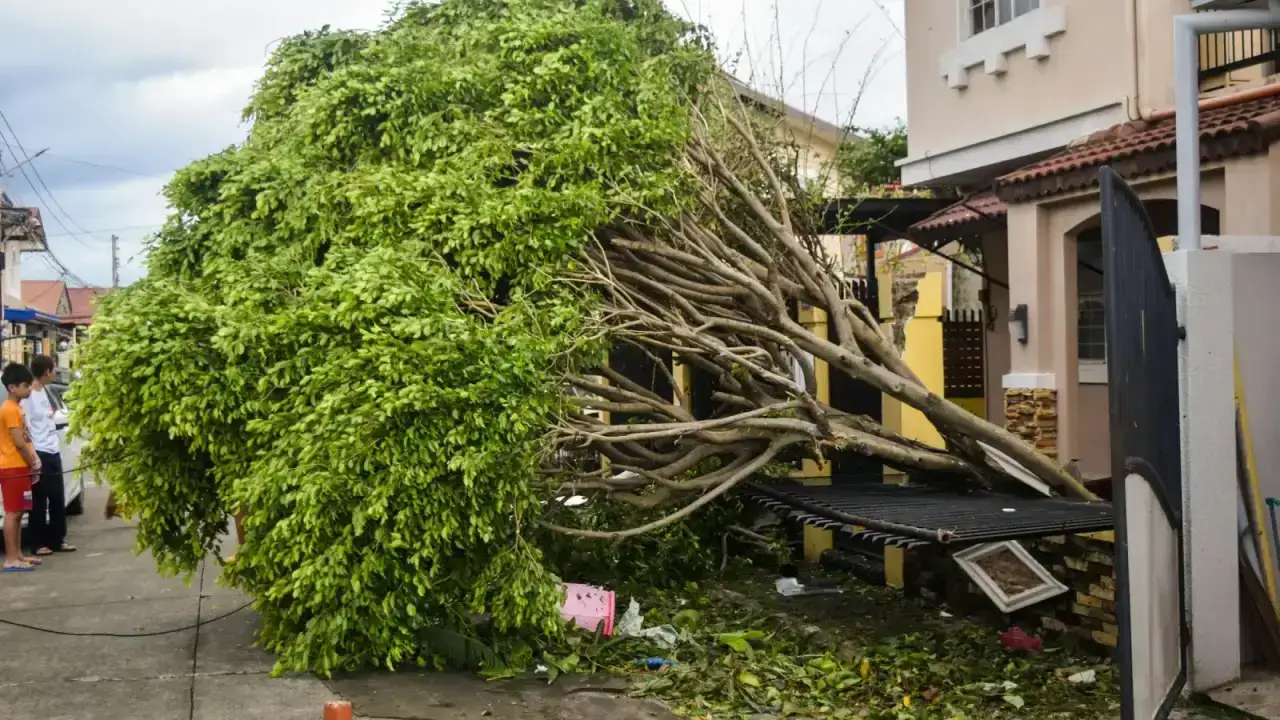
A fallen tree can create several different losses at once: roof damage, a crushed fence, blocked driveway, damaged landscaping, emergency tarping and a large debris-removal bill. Homeowners often ask one question—“Whose tree was it?”—when the insurance answer usually starts with different questions: What caused the tree to fall, what did it damage, and what does the policy say?
When a fallen tree may be covered
State insurance departments commonly explain that a standard homeowners policy can cover damage to the insured home when a tree falls because of a covered event such as wind. California Department of Insurance storm guidance, for example, says damage from fallen trees is generally covered under standard homeowners insurance, subject to policy terms and exclusions. Texas Department of Insurance likewise notes that many policies cover damage from falling trees.
That does not mean every tree-related expense is automatically covered. A policy can treat structural damage, detached structures, landscaping and debris removal differently. Separate wind, hail or hurricane deductibles may also apply in some areas.
Structure damage vs. tree removal
| Situation | Possible insurance response | What to verify |
|---|---|---|
| Tree damages the insured house | Dwelling coverage may pay for covered repair costs | Cause of loss, dwelling limit, deductible and settlement basis |
| Tree damages a detached garage or fence | Other-structures coverage may apply | Coverage B limit and any special limits |
| Tree blocks a driveway or access | Some policies provide limited debris/tree-removal benefits | Specific removal trigger and dollar limit |
| Tree falls in yard without damaging covered property | Removal may be excluded or limited | Whether the policy requires covered property damage or blocked access |
| Tree damages a vehicle | Auto comprehensive coverage, not homeowners dwelling coverage, is commonly relevant | Vehicle comprehensive deductible and policy terms |
What if the tree came from your neighbor’s yard?
A tree crossing the property line does not automatically make the neighbor’s insurer responsible. If a healthy tree is blown down by a storm and damages your house, your homeowners policy may handle your covered damage even though the trunk started next door. If there is evidence that a property owner knew—or reasonably should have known—about a dangerous condition and failed to address it, liability questions can become more complicated and fact-specific.
Do not turn a claim into a legal argument before protecting the property. Notify your insurer, document the tree’s condition and preserve any prior written communications about the hazard. The insurers can evaluate recovery rights after the immediate loss is handled.
How the deductible can change after a storm
Some homeowners policies use a separate wind, named-storm or hurricane deductible. These deductibles may be expressed as a percentage of the insured dwelling limit rather than a simple fixed amount. The NAIC explains that hurricane deductibles are state- and policy-specific and are triggered under defined conditions.
If a windstorm knocks a tree onto the house, check the declarations page before assuming the standard all-peril deductible applies. Our guide to hurricane and named-storm deductibles explains the percentage calculation.
How much will the insurer pay for repairs?
The settlement depends on the damaged property and the policy’s valuation terms. Replacement-cost coverage and actual-cash-value coverage do not produce the same result. Roof age, endorsements, depreciation and the type of property can matter.
For the core distinction, read replacement cost vs. actual cash value. If your policy withholds depreciation until repairs are completed, our guide to recoverable depreciation can also help explain the claim sequence.
What about temporary housing?
If covered tree damage makes the home uninhabitable, loss-of-use or additional living expense (ALE) coverage may pay eligible increased living expenses, subject to limits, time periods and policy conditions. It is not a general living-expense allowance: keep receipts and ask the adjuster which costs qualify.
See additional living expenses and loss-of-use coverage for examples of covered incremental costs.
Steps to take before removing the tree
- Photograph everything. Capture the entire tree, root or break point, damaged structure and surrounding area before major cleanup if it is safe to do so.
- Prevent further damage. Emergency tarping or temporary protection may be reasonable, but do not take unsafe risks.
- Keep damaged materials when practical. The insurer may need to inspect before permanent disposal.
- Save invoices. Separate emergency tree work, debris hauling, temporary repairs and permanent construction.
- Ask about limits before authorizing expensive removal. Tree/debris-removal benefits can have special caps.
- Use qualified contractors. Large storm losses attract fraudulent or unlicensed operators.
Do not underinsure the house just because the tree claim seems small
A large tree can damage several parts of a structure at once. It is useful to understand whether the dwelling limit reflects current rebuilding costs and whether extended or guaranteed replacement-cost features are present. Those features are explained in our guide to extended vs. guaranteed replacement cost.
Frequently asked questions
Will homeowners insurance pay to remove every fallen tree?
No. Removal coverage can depend on whether the tree damaged covered property, blocked an insured structure or blocked access, and policies can impose specific limits. A tree lying in an open yard may not receive the same treatment.
Does it matter whether the fallen tree was mine or my neighbor’s?
Ownership matters for liability questions, but covered damage to your insured home can still be reported to your own carrier. Negligence and recovery against another party are fact-specific.
Does homeowners insurance cover a tree falling on my car?
Vehicle damage from a falling tree is generally handled under comprehensive auto coverage if you carry it, not under the dwelling coverage of a homeowners policy.
Sources & further reading
Reviewed October 6, 2026. Tree-loss coverage, deductibles and liability rules vary by policy and state. Obtain safe emergency help before attempting tree removal yourself.